Twenty Years before John Crnkovich’s Birth Year (1840s)
Today’s world is witnessing a series of revolutions in the Middle East, a part of the world where ruling monarchies still exist. These revolutions will be remembered as, “The Arab Spring,” or “Arab Awakening,” as the countries are predominantly Arab populations. They want a change of leadership, as most of their rulers have been in place for decades. They want what we have in America - some version of democracy, and the opportunities, progress, and human dignity that comes with it. A similar series of revolutions took place in 1848, when most of the world had ruling monarchies. That time in history is referred to as The Revolutions of 1848 or, “The Springtime of Peoples,” but they took place in Europe.
I read about constitutional monarchies and the social hierarchy that played a part in The Revolutions of 1848, and then revisited the who and what of monarchs, dictators, aristocrats, and peasants, in order to understand the players. There were tensions about taxes, remaining serf obligations to the nobility, a continual need for conscripted soldiers, desires to be self-governed, in addition to an economic depression, and food shortages.
It was also about the time that my grandfather’s parents, Matt Crnkovic and Lucille Ugovich, were born. They were born into an area which was slow to participate in the Industrial Revolution, affecting their economic opportunities in life. They were born into a Croatia that was not a democracy, into a part of the world and a time where people had no voting privileges and no representation in their government. The power, land, and wealth were in the hands of the nobility (the “ban” ) and the Church.
In January I started reading about The Revolutions of 1848 and I was surprised when history began repeating itself before my eyes (on TV) in the Middle East – in Tunisia, Egypt, Yemen, Syria, Bahrain, Libya and others. It made it easier for me to relate to 1848, when people wanting rights shaped that time in history. Those Europeans who left undemocratic countries helped create this country, because the seventy years following those revolutions brought waves of immigrants to America.
What Makes a Monarch -and- the Last Croatian King
Theoretically, a King, an Emperor, or Pharaoh, etc. is an absolute ruler, and are given their power over others by God - or are living gods. This type of government can be referred to as an autocracy, with unlimited powers. It is what most peoples knew or accepted for centuries.
When the king died, his first son usually succeeded him. In Croatia’s history, the last Croatian king goes back to 1091. The king died (or may have been murdered), but he left no heirs. His brother-in-law was the King of Hungary and wanted his neighboring country, Croatia. Instead, a Croatian noble was elected king by Croatian lords, but he was soon killed in battle with Hungary. Because it was believed that only a king could rule, the nobility of Croatia, agreed to be ruled by the King of Hungary after five years of negotiations. Hungary agreed that Croatia would remain a separate kingdom, not to settle Croatia with Hungarians, and to allow the local “ban” to govern Croatia.
This transferred rule to a non-blood family member, and birth line succession in Croatia ended. The Croatian nobles traded full independence for security, stability and internal self-rule. Hungarians ruled Croatia (with some border changes and parts occupied by Turkey) until 1918, even when Hungary was under rule by the Austrian Empire. FYI - In the Croatian and Serbian languages, king is “kralj”, where the “j” is silent, spoken in English as “krawl”.
I believed that all ruling monarchs had absolute power, or ultimate authority. But, several had parliaments or assemblies, which had some power or influence, and were elected or appointed. These were “constitutional monarchies”. The Austrian Empire had absolute monarchs within its empire until 1848, so if Hungary had a king he was likely an appointed Austrian family member. Monarchies of the 1800s began to cede some power voluntarily to elected parliaments and prime ministers, but the royals retained authority. Let me further note that "elected" meant that very few had the right to vote - usually the nobility. Certainly, not any female nobility voted back then either.
Some countries today with absolute monarchs are Saudi Arabia, Kuwait, Morocco, United Arab Emirates, and Jordan. To be clear, both absolute monarchs of today, as well as the constitutional monarchies of the 1800s are repressive. They restrict freedom of speech, and opposition is suppressed, even when parliaments or assemblies exist. A “supressed” opposition means people who oppose the monarchy could find themselves beaten, jailed, killed, or they may disappear.
Today, there are symbolic monarchs in Britain, the Netherlands, Belgium, Spain and others. Historically, they had absolute or constitutional monarchs, but today they are symbolic and have “reserve” powers of government that may allow them to intervene in special situations. Mostly, they have a ceremonial role in their government, and are important to their country’s tourism. It is likely that a billion people, on April 29th, will watch on TV the marriage of Prince William of England, in line to become King because of birthright succession. The world will watch the ceremony, not because he will ever make any political decisions for England, but because he is a royal celebrity. In a modern casual world, the royals bring glamour and regalness, as well as nostalgia for a time gone by. They also bring a sense of duty, loyalty, and a continuity over the years, which prime ministers and presidents cannot.
What Makes a Dictator -and- When Napoleon Ruled Croatia
A type of constitutional monarchy or authoritarian government first occurred with Napoleon Bonaparte. He proclaiming himself ruler of France, rather than a divinely appointed ruler. His rule forecast a more modern form of government. Modern history also considers him a dictator.
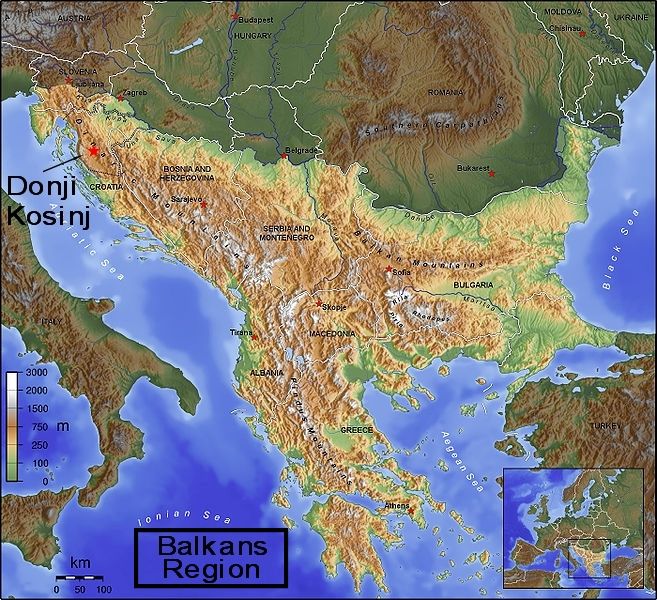
Part of Croatia was under his rule from 1806 to 1813 and his brief rule brought some modernization to Croatia. Napoleon was a military leader, but just as monarchs, he was into conquering other lands and peoples to expand his power. This 1809 map marks Donji Kosinj, birthplace of my grandfather, at a time when it was part of the Illyrian Provinces – part of the French Empire under Napoleon I. (click on map to see details)

Dictators are alive and well in our modern world. They rule by force or decree. Initially, they may have been elected. Often, they have been military leaders that command armies, which give them power by force. Today, as part of the Arab revolutions, the people of Libya are trying to oust their dictator, Colonel Moammar Gadhafi, who declared to the world that he would show no mercy to protestors. Egypt’s President, Hosni Moubarek, was effectively a dictator for 30 years, recently deposed in February. He originally came to power after the assassination of Anwar El Sadat. Mubarek was later elected, but elected rulers become dictators when they use power to stay longer than their elected term.
Rule by decree allows the ruler to create law, without approval by a legislative assembly. One of the worst examples in history is when Germany’s President was convinced by Hitler to issue such a decree indefinitely. Then, Nazi authorities were able to constitutionally suppress or imprison their opposition, which paved the way for the one-party rule of the Third Reich. Many constitutions allow rule by decree, as in democratic Mexico or France, and is to be used in times of emergency. Many of today’s Arab Spring countries have been under emergency rule for decades. Rule by decree would affect Croatia later in their history.
Who Are the Nobility -and- were Crnkovics Nobility?
Remember, in the Europe of 1848, the power, land, and wealth was in the hands of the nobility (and the Church). In the social ranking of people, the nobility ranked high. Nobility status may also be a hereditary and legal status. Some nobility may be the “advisors” around the kings or emperors. And, in the hierachy of the Church, most came from families of the nobility.
The nobility are the local rulers of provinces or lands, and have titles such as duke or prince (England) or viceroys (Croatia), or may be known as “lord, master, ruler.” In Russia, Bulgaria, Ukraine, and Greece, the “boyar” is their noble class. In Croatia, Bosnia, Serbia, and other Eastern European countries, the name for their nobility is the “ban”. As a title, it usually means governor. Even without a Croatian king, and while under the rule of Hungary or Austria, there was legal nobility in Croatia. They were the local land administrators and appointed by the Hungarian King. In the 1800s, Croatian bans became chief government officials and the first Croatian Prime Ministers.
Many nobles were exempt from taxes. In many parts of Europe nobles had the right to “private” wars against other nobles. In the modern age, inherited nobility with special rights is abolished in the Western world. What is the difference between an aristocrat and a noble? Aristocrats can be nobles. On the other hand, they can be without titles, hereditary or legal rights, but aristocrats rank within the social circles of nobles.
Just as I was about to tell you that there were no kings or nobles in our family history, my eyes widened when I saw the name, “Crnković” on a list of families that had nobility status.
Many nobles were exempt from taxes. In many parts of Europe nobles had the right to “private” wars against other nobles. In the modern age, inherited nobility with special rights is abolished in the Western world. What is the difference between an aristocrat and a noble? Aristocrats can be nobles. On the other hand, they can be without titles, hereditary or legal rights, but aristocrats rank within the social circles of nobles.
Just as I was about to tell you that there were no kings or nobles in our family history, my eyes widened when I saw the name, “Crnković” on a list of families that had nobility status.
Ivan Crnković (1611-1672) was promoted to chief commandant of the Frankopan Guard and, thus, the Crnković family acquired lordship status. Through marriage he had entered into a family that had local power for more than 300 years. The family, along with other nobles of Croatia and Hungary, tried to win independence from King Leopold I of Habsburg Austria. Their effort ended badly with their executions, their estates pillaged and confiscated, and their families were forcibly moved out of the area. I don’t know where they were moved to, although some escaped to France and England.
Antun Stjepan Crnković (1782-1848) acquired the title of “Graf” (Count is English equivalent) status in 1842 from the emperor Franz Joseph I for ending an uprising in 1833. He was the chief commissar of Zagreb at the time of the uprising. Where they lived in Zagreb is not near where my grandfather came from, so it is not likely that there is a hereditary connection, although possible. Based on my father’s visit to Croatia in the 1970s, there was no mention of such status, and the family’s social status at the time would have fell into a low economic status.
The Peasantry in 1848
Peasants are the people who make up the largest group in the lower hierarchy of society. They work all the basic jobs such as farmers, carpenters, metalworkers, servants, bakers, etc. In every civilization there are peasants. There were free peasants. And those that were slaves were serfs, and they belonged to the land. Whoever owned the land, owned them. There is a hierarchy of serfs/peasants, which varied over time, and region. The legal status of a man determined his rights.
In most countries, peasants were not only under the control of monarchies, but also bound to labor under nobles and aristocrats, which were similar to slaveholders of the southern states in the United States. Our southern states’ culture and customs could be loosely compared to European nobility. Our southern plantations would compare to European manors.
France abolished serfdom in 1789. Austria abolished serfdom about 1781, but there were exceptions. Romanian Orthodox Monasteries and boyars were one exception. Their slaves were Romas, or as we know them, gypsies. In 1848, Austria’s Wallachia and Moldavia, (present-day Romania) still had slavery. Serfdom remnants were abolished in 1848 in Hungary (April) and Croatia (May), as well as all of Austria’s Empire (September). Russia did not free their serfs until 1861. America did not free their slaves until the Emancipation Proclamation, in 1865. As our Civil War began in 1861, we are remembering that time in 2011, 150 years later.
European nobles, bans, or boyars could impose taxes, labor and/or require a portion of the annual crop yield from peasants or nobles of lower rank who lived or worked within their land. In some countries, the local lord could impose restrictions on a peasant’s movements, their religion, or legal actions. The nobles were in control of the courts and police. Peasants were not just poor, but lived with few rights and a social status that kept them poor.
When serfs were emancipated, they continued to work for a land owner, or they could leave the rural farms and move to the city, where they became poor laborers. Their social status hardly changed. This was not unlike slave emancipation in America. Many remained in the tradition of their ancestors, of working for a landowner, even if they now owned land. Their parcels were too small to sustain a family and what they owed in payment to the state or landlord kept them somewhat indentured. They often worked another's land in addition to their own. Life was not very different despite land reforms before or after The Revolutions of 1848.
I do not know specifically what the life of a peasant was like in Croatia, or what type of peasant my ancestors were. Medieval peasantry and Russian peasantry are well studied, but I could not find information about my grandfather’s region during the 1800s. The revelation to me is how much of the world was enslaved or lived without freedom in the mid 1800s. Perhaps 80-90%? This really had me thinking that of the last two thousand years or more...that only in the last two hundred years have people been gaining their freedom.
The Influence of Nationalism in the 1800s
Prior to the 1700s and 1800s in Europe, people did not have a “nation” identity, only a sense of where they lived. People lived in smaller agrarian communities, identifying themselves as living within the territory of a noble’s land, or “ban” in Croatia. Many countries had multiple ethnicities and languages because of migration, territory annexations, or occupation because of war. Now, the Industrial Revolution was changing where people lived and how they lived.
The American Revolution and French Revolution in the late 1700s had popularized the idea of freedom and equality. New philosophies about democracy, socialism, communism, unification, and nationalism were gaining attention in Europe.
Nationalism is the belief that person’s loyalty should not be to a king or empire, but to the nation. Of most importance to Nationalists was a common ethnic ancestry. Shared language, culture, history, and religion also connected people. Such groups with like characteristics, and with their own government, were defined as nation-states. Leaders realized that this could unite people. Rulers saw it differently. These nationalistic feelings could break apart empires such as the Austrian Empire, and nationalistic feelings has considerably affected Croatia until the present day.
The Revolutions of 1848
Discontent grew among the lower classes because they could see the disparity in their living conditions vs. the reigning and privileged classes. Many uprisings occurred prior to 1848, including an 1846 peasant revolt against serfdom in Galicia (Poland), where 1000 noblemen were killed by peasants and 500 noble manors were destroyed. Throughout Europe, a financial crisis and poor harvests also brought an economic depression and mass unemployment.
People took to the streets of France in February of 1848. Some wealthy militia and army garrisons abandoned the king and joined the protesters. The King of France attempted reforms, but workers rejected them. The monarchy was overthrown and this encouraged protests throughout Europe, led by radicals and workers. They demanded constitutional reform or a complete change of government. They wanted self-government, not authoritarian or absolute rulers. Without the help of phones, cell phones, telegrams, TV, Twitter, or You-tube communications, protests quickly spread in a couple of months to other European countries.
Revolution came next to cities in some of the forty plus German provinces, including Prussia (Berlin), Austria (see below), Baden (Kandern) and Saxony (Dresden). These provinces were constitutional and absolute monarchies, wanting civil liberties and a united Germany, rather than independent states. (Prussia is present-day northern Germany and Poland.)
In the greater Austrian Empire, revolts occurred from March 1848 through July of 1849, in Vienna (Austria), Budapest (Hungary), and Prague (Czech). Present-day Slovakia rebelled against Hungary. Italy had revolutions in many of its states, kingdoms, and duchies against Austria, including Salerno, Naples, Milan, and others. By December, Emperor Ferdinand I fled Vienna and was forced to abdicate in favor of his nephew Franz Joseph. In the end, the revolts failed and promises to make changes also failed.

Protests and riots began in Hungary on March 15, 1848 and conflicts continued for a year and a half, with armies becoming involved to fight for the monarchies or for independence. Russia helped Austria quell the conflict in the end, marching with 300,000 troops into Hungary. Croatia’s military cooperated with Austria against Hungary in the revolts, participating in at least four battles against Hungarian armies. Croatia had been resisting Hungarian demands and aggressiveness and so, sided with Austria. The Ban of Croatia (and also of Slavonia) at the time was Josip Jelacic, who was a noted army general remembered for his military campaigns during the Revolutions of 1848 against Hungary, and the abolition of serfdom in Croatia. See his portrait.
More struggles occurred in Switzerland, Poland, Wallachia, Ireland, and Belgium. Denmark had protests but its monarch successfully managed the situation with reforms, unlike the rest of Europe.
Tens of thousands were killed and tortured across Europe during these protests. It was a time of revolts and challenges to the rule of kings, the aristocracy, and the Church. The Church dioceses were land owners. Church bishops and clergy were from noble families, which often put them on the wrong side of the situation. Royal power was weakened, but the royals prevailed because their armies put down all revolutions. The revolutions failed because of lack of organization by protesters.
Reforms and negotiations that followed failed due to political squabbling. Democracy and freedom usually comes as a difficult and slow process, and The Revolutions of 1848 it did not achieve their goals. The map shows an unchanged Austrian Empire in 1848 - Hungary and Croatia are still ruled by Austria.

The super powers of the time, Austria, England, France, Prussia and Russia had a prior agreement that no one nation should gain excessive power within their continent. The Revolutions of1848 changed this political cooperation between countries. After 1848, they seemed incapable of united action to maintain the balance of power in Europe. The super powers provoked each other at times, and, some intentionally were breaking the cooperation by appearing to remain neutral in the smaller wars around them. Secretly, they were providing support, in exchange for territory gained at the end of these smaller wars.
Minor countries found themselves continually under different rulers. Some looked around and “unified” politically to make them stronger against the aggression of larger countries. You will see later that Croatia partnered with Slavonia.
One Year Before - 1867
Almost twenty years after The Revolutions of 1848, the desire for independence and self-governance still kept Europe busy with protests, and war. Both Prussia and Austria continued to compete for dominance over a number of small principalities, despite their like characteristics and an attempt to unify twenty years earlier. Austria lost in the Austria-Prussian War of 1866. Croatia did not participate in this war, although Austria’s loss of wealth and power affected Croatia. It led Austria to negotiate with Hungary, which also affected Croatia.
In the year before my grandfather was born, Austria dealt with Hungary’s continued desire for independence, with the Austro-Hungarian Compromise of 1867, also known as The Dual Monarchy. In Austria’s German language, it is the Ausgleich of 1867. (Sometimes it's difficult to follow history with so many versions!)
In this agreement signed on March 30, 1867, Hungary didn’t gain independence, but became more equal with Austria. (If you can’t beat them, join them!) Hungary benefited by unity with a wealthier, more industrialized Austria. Austria retained territories by negotiation, rather than potentially losing them in further wars. They were ruled peacefully for the next 45 years, except for later tensions in the Balkans.
The agreement divided the Austrian Empire into two states and became Austria-Hungary. Each state had a capital - Vienna in Austria, and Budapest in Hungary. They each had a parliament, a prime minister, and government. Common ministers served both states regarding foreign affairs and defense, along with an equal delegation of members from both states that discussed common affairs.
This was a very multicultural union, with many ethnic groups and languages. The four chief groups were Germans, Hungarians, Slavs, and Italians. Austria gave Hungary authority over the ethnic minorities in their territory – the Slavs (Croats, Serbs, Slovaks), the Romanians of Transylvania, and part of the Dalmatian coast (Italians). Austria traded this for keeping the role of managing foreign affairs and defense.
In the map below, the darker orange-colored areas are those areas that Austria continued to govern and Hungary governs the solid yellow areas. The areas with green lines slashing the yellow areas, are not governed by Hungary, even though they appear to be in Hungarian territory. Learn in the next post as to why. See map below of the new union between Austria and Hungary.
In the map below, the darker orange-colored areas are those areas that Austria continued to govern and Hungary governs the solid yellow areas. The areas with green lines slashing the yellow areas, are not governed by Hungary, even though they appear to be in Hungarian territory. Learn in the next post as to why. See map below of the new union between Austria and Hungary.

John (Ivan) Crnkovich’s Birth Year - 1868
Considering that Croatia came to Austria’s defense against Hungary in 1848, this union wasn’t great for Croatia. Croatia was still to be ruled by Hungary, but Croatia was given special status because Emperor Franz Joseph of Austria insisted that Hungary and Croatia negotiate their union. Croatia was allowed some self-governance, but Hungary was to choose Croatia’s governor, or “ban”. This agreement was the Hungarian-Croatian Agreement of 1868. It did not make changes in territorial borders.
Also in 1868, the separate kingdoms of Croatia and Slavonia joined into one single kingdom, called, The Kingdom of Croatia-Slavonia. This was about two smaller states unifying for strength against others, while still being part of the Kingdom of Hungary. They tried to add the Kingdom of Dalmatia to their union, but it didn’t happen in the end. The map shown below represents the territory of the unified kingdoms from 1868 until 1881. 

This political unification lasted until 1918, although Croatia was given some authority over Slavonia. Moreover, this new kingdom was still under the authority of the new Austro-Hungary created the year before. The “king” of this union, Franz Joseph I, had the title, “King of Croatia and Slavonia”, and as Emperor of Austria. Franz Joseph I had at least seven “king” titles, including King of Hungary, along with other titles, such as Archduke, Grand Duke, and more. He did not directly rule the smaller provinces or kingdoms. A “Ban of Croatia and Slavonia” was appointed to govern the Kingdom of Croatia-Slavonia. Slavonia today is a historical reference and eventually most of it became part of present-day Croatia.
Alot of the "unions" were difficult for me to follow when pulling together who was ruling who, and what impact the treaties actually had on Croatia. If summarized, Austria+Hungary now ruled together but there were provinces they individually ruled. Compare it to our Federal laws superceding some state laws, and ...then we live under county, city or village laws. It is a system that can efficiently distribute services and manage territory and people's needs. In 1868, Austria+Hungary used a similar system, although people did not have elected officials representing them, nor freedom of speech, etc. The hierarchy was Austria+Hungary, Hungary-->Croatia-->Slavonia. Each country also had counties, towns, or villages that may also have had local rules. Hungary was pressuring and changing law within their provinces, which included Croatia, to make Magyar (Hungarian) the official language, to eventually assimilate and unite their provinces. The provinces saw this differently. For them, Nationalism continued to gain favor because people wanted a sense of belonging and a voice in their destiny....something better than foreign rulers or restrictions because of birthright.
Alot of the "unions" were difficult for me to follow when pulling together who was ruling who, and what impact the treaties actually had on Croatia. If summarized, Austria+Hungary now ruled together but there were provinces they individually ruled. Compare it to our Federal laws superceding some state laws, and ...then we live under county, city or village laws. It is a system that can efficiently distribute services and manage territory and people's needs. In 1868, Austria+Hungary used a similar system, although people did not have elected officials representing them, nor freedom of speech, etc. The hierarchy was Austria+Hungary, Hungary-->Croatia-->Slavonia. Each country also had counties, towns, or villages that may also have had local rules. Hungary was pressuring and changing law within their provinces, which included Croatia, to make Magyar (Hungarian) the official language, to eventually assimilate and unite their provinces. The provinces saw this differently. For them, Nationalism continued to gain favor because people wanted a sense of belonging and a voice in their destiny....something better than foreign rulers or restrictions because of birthright.
None of these unions affected John Crnkovich’s parents directly. They did not live in the Kingdom of Croatia-Slavonia, nor were they part of Hungary when my grandfather was born …a mystery to reveal next time. While living in Croatia, my grandfather lived his entire life under Austria's Emperor Franz Joseph.
My grandfather, Ivan Crnkovic, was born to Matt and Lucille Crnkovic on May 25, 1868, in the village of Donji Kosinj, Croatia. I will think of him this year on May 25th, as this is the first year that I ever knew of his birth date. There are no photos of him as a child, or of his parents.
*Maps best represent the territory at the time and are in the public domain.
*Moammar Gadhafi has multiple spellings, as well as other translated names used here.
*Ivan Crnkovic later changed his name to John Crnkovich, after moving to America.
*Matt Crnkovic's given name, Matt, was likely Matej in the Croatian language. I have been unable to determine what Lucille translates to in Croatian. Lucille might have been Louise or Loisa, but I couldn't find those names in the Croatian language.